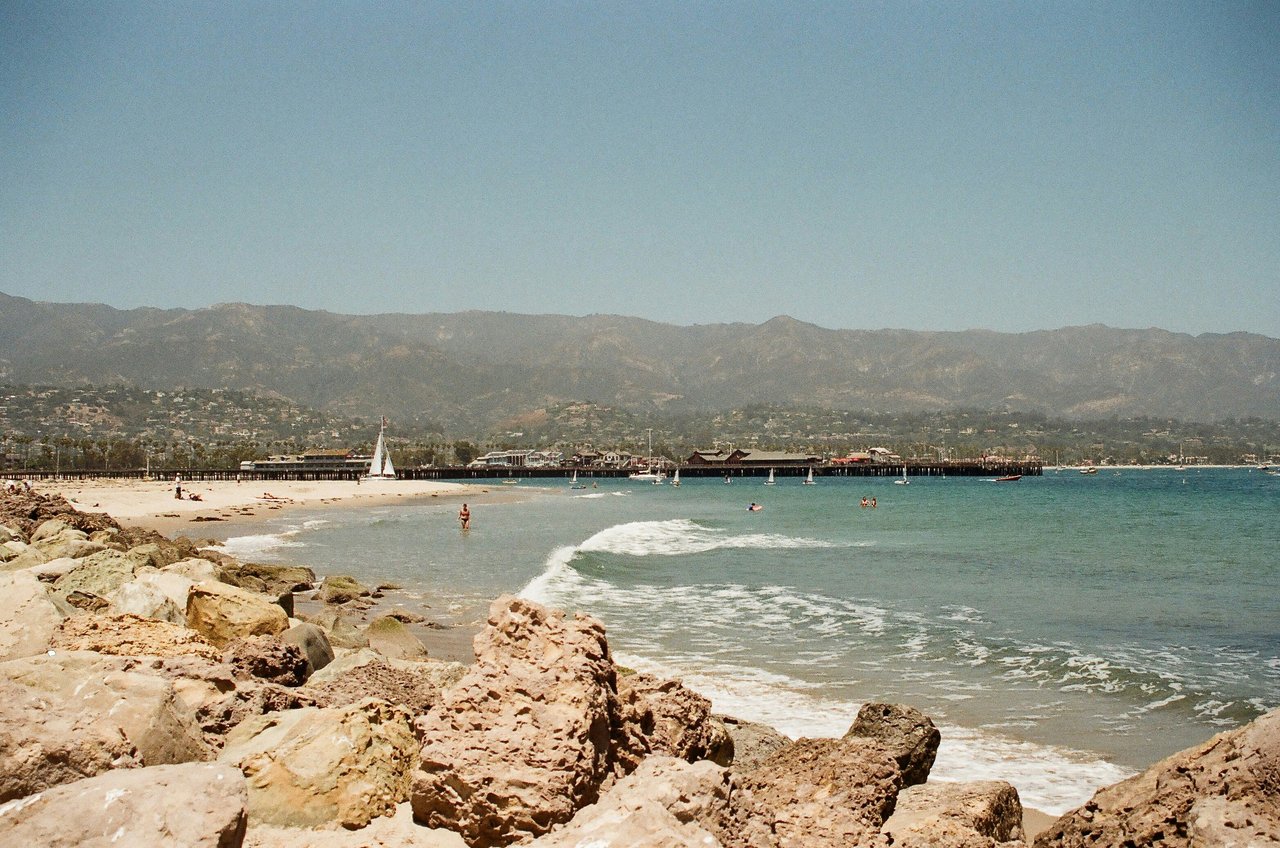
"It's something I've always just accepted as the Hope Ranch volcano," Santa Barbara County Fire spokesperson Michael Gray said this past April, watching smoke curl off the same stretch of bluffs it always curls off of. He was describing a scene that anyone who has lived in Hope Ranch for more than a few years already recognizes on sight: a plume rising above the cliffs west of Arroyo Burro Beach, visible from as far away as the UC Santa Barbara campus, pulling the same fire engines to the same corridor of coastline they've answered calls to before.
It is not a volcano. There are no volcanoes in Santa Barbara County. What's actually under those bluffs is a chemical reaction, and it has been happening long enough, and often enough, that the more interesting story this year isn't the smoke itself. It's what the county said it would fix after the last time this happened, and what turned up in the ground when the smoke cleared this spring.
What's Actually Burning Under the Bluffs
The cliffs between Hope Ranch Beach and Arroyo Burro Beach sit on Monterey shale, a rock formation laced with iron sulfides and natural hydrocarbons. When erosion or a landslide exposes that layer to oxygen, the minerals react and generate heat on their own, no spark required. Under the right conditions, that heat climbs high enough to ignite the oil trapped in the shale, which produces smoke and, occasionally, a small brush fire on the vegetation above it. Geologists sometimes call it a solfatara, a term usually reserved for vents that release steam and sulfurous gas, though even that label is a stretch here since the activity is a surface-level reaction rather than anything geothermal happening deep underground.
UC Santa Barbara geochemistry professor David Valentine, who studied the phenomenon after this year's flare-up, put the history in a frame that's easy to picture: early Spanish explorers sailing along this coast saw smoke rising from these same bluffs and assumed they'd found settlements.
"When the early explorers came along the California coast, they actually thought there were habitations in the Santa Barbara area because there were many of these fires, and they thought they were campfires."
That detail matters because it means this coastline was smoking before Hope Ranch existed, before Santa Barbara existed, before the idea of a fire department existed to respond to it.
A Pattern With Decades of Paper Trail
What separates the Hope Ranch volcano from a one-off news item is how long the record actually runs. Spanish colonial governor Pedro Fages described "geysers that exude dense smoke" below present-day Hope Ranch back in the 1780s. In the 1920s, the vents reportedly glowed with hot coals at night, drawing enough curiosity seekers that a few annoyed residents ran a garden hose to the fissure in an attempt to drown it, an attempt that didn't work. A major flare-up in 2006 required round-the-clock dousing from sprinklers fed by hundreds of feet of hose, with resident Dr. Mel Goldsmith, who lived directly above the fire, telling reporters the smoke had dropped by 95 percent only after days of continuous water.
The modern cluster of incidents is the part most current residents actually remember:
- 2017 and 2019 — recurring small vegetation fires along the same bluff corridor
- December 2020 — another flare-up, prompting a Santa Barbara Independent follow-up
- July 2021 — a weekend blaze knocked down quickly by crews, with Governor Fages's 18th-century account resurfacing as the earliest known reference
- August 2024 — a fire centered on an underground plastic drainage pipe, after which the county announced it would swap that pipe for metal
- April 2026 — smoke visible from UCSB's campus, again traced to an underground drainage pipe on the same stretch of bluff
The location barely moves between incidents, consistently described as roughly a mile to a mile and a third west of Arroyo Burro Beach, near Marina Drive. The trigger mechanism doesn't change either. What changes is only the year.
The Fix That Was Supposed to Land Before This One
Here's the detail that separates this year's story from every rerun before it. After the August 2024 fire, Battalion Chief Adam Estabrook told local reporters the county planned to replace the petroleum-based plastic drainage pipe in that corridor with metal, specifically because plastic ignites easily under the heat these geological fires generate. It read at the time like a fix, not just a monitoring plan.
Then, in April 2026, Noozhawk and edhat, both covering the new smoke, described the fire as centered on an underground PVC drainage pipe. Plastic. The same material the county said it would phase out nearly two years earlier.
That doesn't necessarily mean the fix failed. Hope Ranch's bluff corridor runs long, and infrastructure upgrades along a stretch of coastline this size tend to happen section by section rather than all at once. But for anyone living along Marina Drive, above this stretch of bluff, the practical read is straightforward: an announced fix and a fully completed fix aren't the same thing, and two years after the county said plastic pipe was on its way out, plastic pipe was still what caught this spring.
What to Actually Do If You Smell It
If you're new to the neighborhood, the smell is the tell before the smoke is. Longtime residents describe it as similar to a roof being tarred, and it's strong enough to carry roughly a mile inland on the wrong wind. The fire department's standing message hasn't changed across a decade of these incidents: this is naturally occurring, but if you see actual flames or heavy smoke, call 911 anyway and let crews confirm what's happening rather than assuming it's benign on your own. No structures have been damaged in any of the documented incidents, and evacuations haven't been part of the response in recent years. Crews typically monitor the site, knock down any brush fire that starts, and let the underlying reaction burn itself out.
Living Alongside It
Most neighborhoods don't have a landmark that predates their own founding, let alone one that Spanish colonial officials wrote about in the 1780s and that UCSB scientists are still explaining in 2026. Hope Ranch does. It's not a hazard residents organize their lives around, and it's not something anyone is trying to sell as charm. It's just part of what this particular stretch of coastline does, on a timeline measured in decades rather than seasons, and it's the kind of detail that tells you something true about a place: the smoke has outlasted every fix anyone has tried on it so far.
If you already call Hope Ranch home and you're curious what a market shaped by 773 lots and a genuinely small pool of annual sales means for your own property, our team at David Kim Group spends its time in these specifics, not just the headline numbers. You can also find more on the neighborhood's character in our Hope Ranch guide. Get your free home valuation whenever you're ready for a straight answer grounded in what's actually happening here, smoke included.