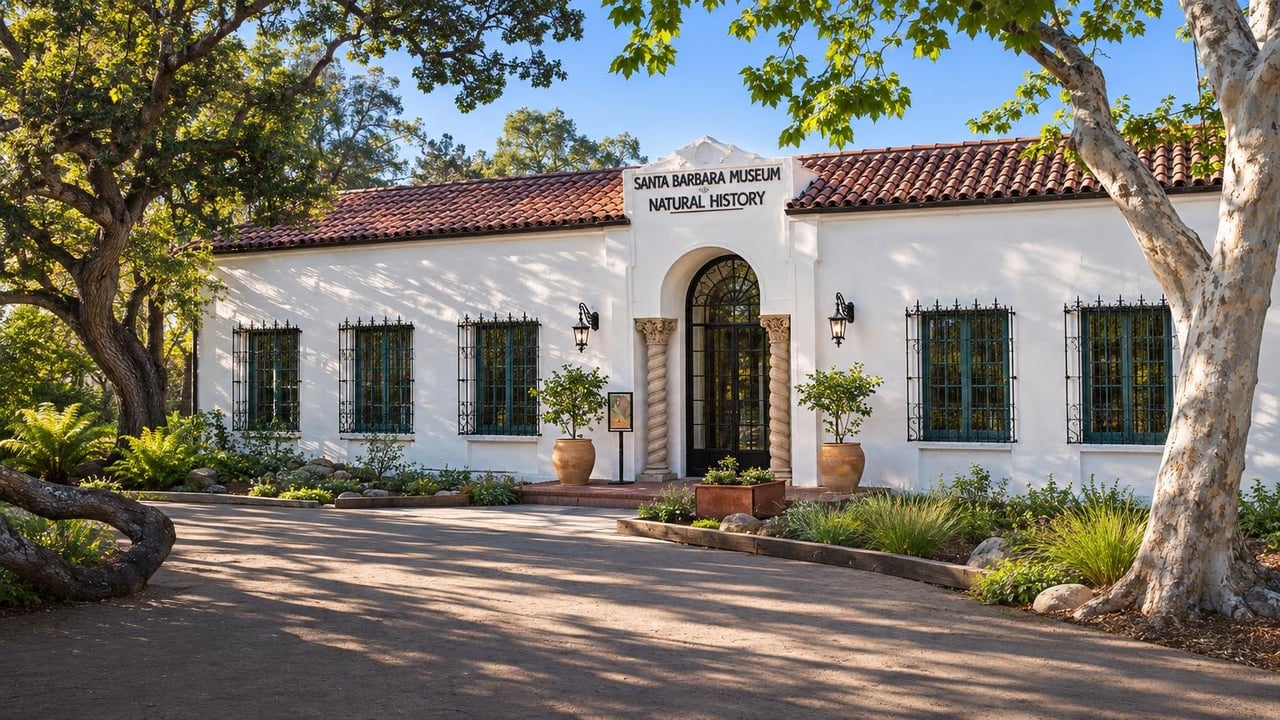
The Santa Barbara Museum of Natural History added Gould Hall in 1926 for its growing anthropology collections. For nearly a century the room has kept that focus on Chumash collections while its name changed. That ends on Monday, November 30. It is the last day to see Chumash Basketry: Art & Life in its current space. A lightly updated version reopens December 21 in Fleischmann Auditorium.
For anyone who lives up Mission Canyon Road, the basketry move is the first visible part of a larger change on the museum's campus. The baskets are leaving so the halls on the west side of the courtyard can be rebuilt. The museum's Western Galleries Campaign is the final phase of a 20-year effort to update its permanent galleries. The museum is closed today for Thanksgiving, so Friday through Monday are the last four days to see the baskets in the room built for them.
What Is in Gould Hall Through Monday
Chumash Basketry: Art & Life opened at noon on January 25, 2025. The Santa Barbara Independent described it as the first comprehensive exhibition drawn from the world's largest collection of Chumash baskets. Before it, the only major exhibition of Chumash basketry had been held at UCSB in 1964.
The exhibit covers the full range of uses: baskets woven tightly enough to store water and cook in, and baskets made as art. Historic pieces sit alongside work by contemporary Chumash weavers, including Samantha Sandoval and Susanne Hammel-Sawyer. Quotes from Chumash elders and weavers on what basketry means to them run through the galleries. Curator Emeritus Jan Timbrook organized the show. She told the Independent that "baskets are more than beautiful objects" and that "they offer a window into Native peoples' partnership with the natural world, their deep knowledge, their everyday life, beliefs, creativity, history, and resilience."
Look closely at the plants. The exhibit teaches how to recognize the specific native plants that weavers tend, harvest and prepare, and it describes that work as part of a living tradition that weavers are passing on to their children. Gould Hall also holds a Chumash plank canoe, or tomol, that never went to sea. Fernando Librado Kitsepawit saw the last original tomols as a boy in the 1850s. In his seventies he shared those memories with the anthropologist John P. Harrington, and in 1915 the two built this tomol for display.
Where the Baskets Go on December 21
The museum calls the move a homecoming. Fleischmann Auditorium opened in 1937 and has shown exhibits on Native American cultures since 1938. It is also home to the historic tomol known as the Helek. The museum says it is "excited to return exhibits about people and living cultures" to the space it describes as "the central space where we come together as a community."
The December listing for the reopened exhibit says the baskets will share the auditorium with the Helek. The auditorium is ADA accessible, and the exhibit stays included with regular admission. Members get in free. The same collections will be together in one room on the courtyard instead of in the 1926 wing.
What the Move Opens Up on the West Side of the Courtyard
The basketry exhibit is moving because Gould Hall is getting a new job. The Western Galleries Campaign covers three spaces: Earth & Marine Sciences, and the hall most recently known as Chumash Life, which is Gould Hall. The museum's plan is for these west-side galleries to tell the story of the Central Coast through its oceans, landscapes and wildlife, and through the science and collections that document them.
The budget is $5.7 million. Of that, $3.5 million is for exhibit renovation and $2.2 million is for infrastructure. The infrastructure share is already fully funded through unrestricted bequests. The work covers historic diorama restoration, new exhibits, LED lighting, HVAC, accessibility upgrades and other repairs in halls built 70 to 100 years ago. Fundraising began in 2026 and runs through 2027. The museum's campaign progress page lists $3.8 million contributed toward the $5.7 million goal. The project team includes Mithun Architects and Schipper Construction.
Each hall gets its own plan. The Earth Science plan calls for updated dioramas and new interpretation of the Central Coast's geological, climatic and biological history. The Marine Science plan restores dioramas and adds new displays, including a whale-fall exhibit and stories about local marine conservation.
Gould Hall changes the most. Once the Chumash and other anthropology collections are on display in the auditorium, the hall will be used for other exhibitions. The first, set for early 2028, will draw on the museum's collection of more than 3.5 million specimens and artifacts. It will show rarely seen pieces from anthropology, ornithology, geology, paleontology, entomology and other fields, and how collections support research and conservation. The campaign page targets April 2028 for the renovated galleries to reopen.
Earth & Marine Sciences remains open in the meantime, as do Mammal Hall and Bird Hall. Chad, the blue whale skeleton, stays on view as well, and you can see it free from the parking lot. That makes this holiday weekend a good time to walk the west-side halls as they have looked for decades, since those halls are next in line for the rebuild.
Fitting the Visit Into the Long Weekend
The museum is open 10 a.m. to 5 p.m. daily, except today. Admission is $20 for adults 18 to 64, $17 for seniors 65 and up, and $13 for children 2 to 12. Children under 2 and members get in free. If you're bringing out-of-town family, Saturday and Sunday have the most going on. Storytime in the Backyard runs from 11:30 a.m. to noon both days at the stump circle in the Museum Backyard.
The Gladwin Planetarium starts a new show schedule on November 28, with the same lineup both weekend days:
- 11 a.m.: The Night Sky for Little Dippers
- Noon: Who's Afraid of Black Holes?
- 2 p.m.: El Borde de la Oscuridad
- 3 p.m.: Exploring Tonight's Sky
Shows are free with museum admission. Tickets are released 20 minutes before each show, and seating is first come, first served. Two temporary exhibits are still up: Selby's Circles: Art & Nature in Romantic Britain runs through January 4, 2027, and Dinorama runs through March 14, 2027.
Pair the baskets with a walk to Across the Creek, across the bridge on the south side of Mission Creek. That area holds the Sukinanik'oy Garden of Chumash Plants. Sukinanik'oy is Barbareño Chumash for "bringing back to life." The museum created the garden with Chumash people to preserve traditional plant knowledge, and it covers plants used for food, medicine, clothing, shelter, tools and basketry. You can learn the weaving plants indoors and then find them growing outside. Noozhawk photographed Mission Creek flowing on the morning of November 19, after a storm that left 2.7 inches of rain downtown in the 12 hours ending at 8 a.m. that day. The rocks along the creek are slippery when wet. The Across the Creek area is not ADA accessible, but the Backyard is.
You can easily add two stops down the hill. Old Mission Santa Barbara is closed today. Its self-guided tours run Monday through Saturday from 9:30 a.m. to 4 p.m., and Sundays from 12:30 to 4 p.m. Across the street in Mission Historical Park, the A.C. Postel Memorial Rose Garden has more than 1,500 rose bushes. It is open from 9 a.m. to sunset. Winter pruning leaves it without blooms from January through March, so the next few weeks are the last stretch of flowers until spring.
If you head farther up the canyon, the Santa Barbara Botanic Garden is open daily from 10 a.m. to 5 p.m. by reservation. Its centennial exhibition Still Growing: 100 Years of California's Native Plants runs through March 21, 2027. We wrote about the Garden's centennial year in Mission Canyon's Garden Turns 100 by Opening What It Usually Keeps Closed.
Mark two dates: Monday, November 30, for the last look at the baskets in Gould Hall, and Monday, December 21, when they reopen in Fleischmann Auditorium beside the Helek.
At David Kim Group, we're glad to share what's changing up the road in Mission Canyon, from a gallery move at the museum to the Garden's centennial. If you own a home a short walk from Puesta del Sol and want to know what it's worth today, ask us for a free home valuation.