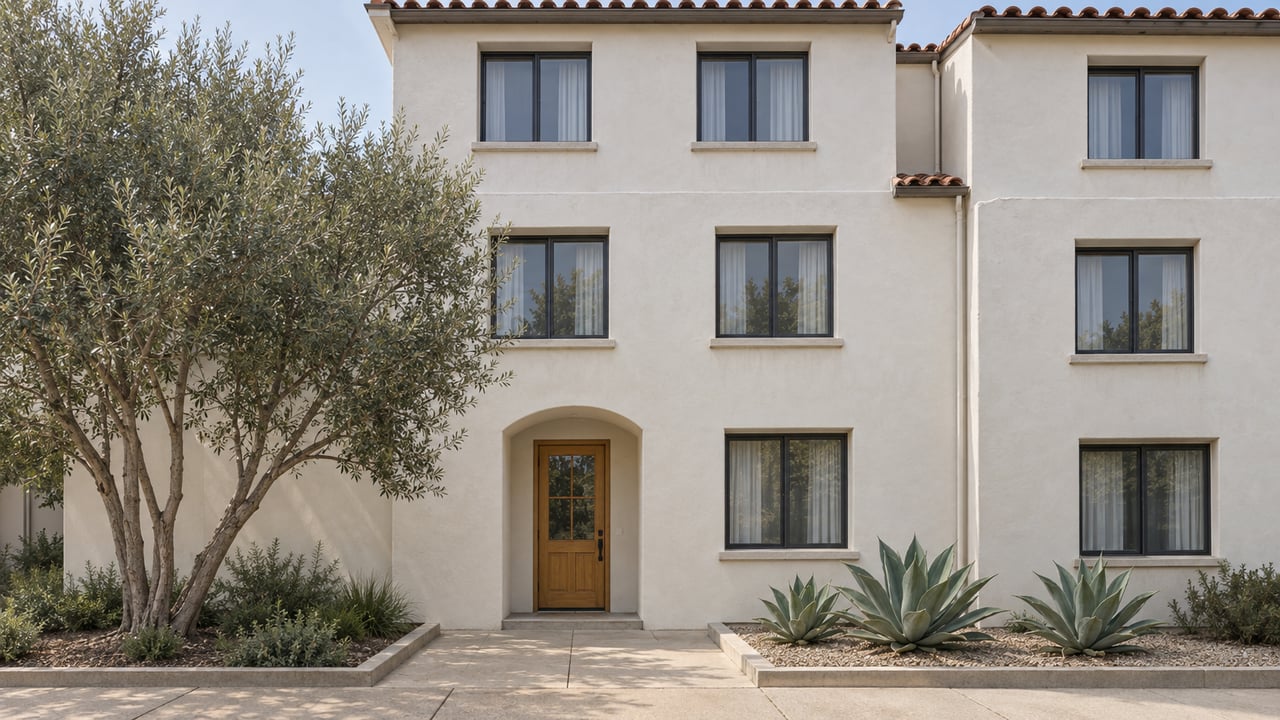
On August 24, Goleta's Planning Commission voted 4–0 to approve 59 for-sale townhomes at 7360 Hollister Avenue. The homes are solar, all-electric, and range from 1,292 to 1,628 square feet. Each has a private garage and patio. The development manager for the developer, City Ventures, told Noozhawk the homes "are meant to be first homes for future homeowners."
If you are comparing South Coast neighborhoods with a Goleta budget in mind, the shape of that project matters more than any single listing. Goleta's next for-sale homes are coming in as three-story attached townhomes in condominium communities, each run by an HOA, with a small number of deed-restricted units mixed in. Local taste did not settle that shape. State housing law did, along with the math that decides how many affordable units a builder includes on site. The city's power to redraw it, one project at a time, is limited.
A Detached Market With Little Slack
Start with what a buyer finds in resale today. The Santa Barbara Association of Realtors' September 2026 chart summary shows 219 Goleta houses and PUDs closed through the first nine months of 2026, at a year-to-date median of $1,650,000. At the end of September there were 42 active listings, 29 pending, and 1.4 months of inventory. In September alone, 24 closed escrows had a median of $1,670,000.
That inventory figure is tighter than where Goleta ended last year. In the association's 2025 year-in-review in the Santa Barbara Independent, Goleta had two months of inventory at the end of 2025. The review said buyers in the $1 million to $1.5 million range faced heavy competition, with many properties selling in the first few weeks and some within days.
So Goleta's entry tier is already crowded, and the new supply approaching it is attached product. Ruling out townhomes means competing for a shrinking slice of the market, which makes it worth understanding how these projects get built.
Why a City Vote Carries Less Weight Than It Seems
The Hollister approval moved quickly, and the city's own staff report explains why. According to Noozhawk, the staff report said the Housing Accountability Act and Senate Bill 330 "significantly restricted" the city's authority to deny or condition the project. The project falls under those laws, and under State Density Bonus Law, because it includes three very-low-income units.
The commission did shape the final plan. A September digest from Central Coast Economics reported that the final approval was amended to 12 buildings at 38.5 feet. Noozhawk reported that the staff report's earlier figure of 13 buildings was an error. The city also secured street work. The project would restripe Hollister and change the existing median to add a left-turn pocket into Cannon Green Drive.
The second City Ventures proposal shows the same dynamic under more pressure. At 5955 Calle Real, the developer proposes 44 three-bedroom townhomes plus two live-work homes, with floor plans from 1,333 to 1,672 square feet. On September 8, Goleta's Design Review Board voted 6–0 to recommend that the Planning Commission deny the revised design, Noozhawk reported. The project still moved forward to the Planning Commission. It was set for an October 12 hearing, and the agenda noted the applicant's request to continue it to November 9.
The Three Units That Set the Math
Goleta's inclusionary housing rule requires 20 percent of units to be affordable, with a 55-year term. Yet the Hollister project includes three deed-restricted homes out of 59. The gap closes in a specific way, laid out on the city's project page:
- Three very-low-income units, 5 percent of the 59, qualify the project under State Density Bonus Law.
- That qualification is what places the project under the state protections that limit the city's discretion.
- The rest of the inclusionary obligation is met through the city's in-lieu fee option.
- The three units will be deed-restricted for 55 years. When Noozhawk covered the August hearing, their locations within the project and their prices had not been set. The developer explained that the rates are determined by the California Department of Housing and Community Development and change every year.
Calle Real follows the same pattern. It proposes two very-low-income units and pays in-lieu fees for the rest of its inclusionary requirement.
This is the mechanism that headline price data misses. A small on-site affordable share brings a project under state protections, and fees cover the rest. That makes the market-rate townhome the default product, and it explains why two proposals from the same builder look so much alike.
Goleta Is Trying to Close That Pairing
The city has noticed. On October 26, the Planning Commission took up case 26-0001-ORD, a proposed amendment to Chapter 17.28 of the municipal code, with a staff recommendation to send it to the City Council. As summarized in the Central Coast Economics weekly brief, the 20 percent requirement and the 55-year term stay the same. What changes is how a builder can comply.
The proposal makes on-site units, off-site units, land dedication, or on-site plus off-site units "objective" options that need no special findings. In-lieu fees would still require them. Off-site units would have to be in Goleta, use the same exterior finishes, and average at least 90 percent of the market-rate units' floor area and bedroom count. The provision most relevant to the Hollister model would bar pairing a requested in-lieu fee with an objective option. The staff report says that rule prevents a builder from providing just enough on-site units to unlock density bonus benefits and paying fees for the rest. Staff said the item would go to the City Council after Planning Commission action.
If adopted, the change would apply to future applications. It would not undo what Hollister already has.
Winslowe Already Ran This Experiment
Goleta has seen a City Ventures townhome project before. Old Town Village, marketed as Winslowe, came to the City Council in 2015 with 175 units: 113 traditional townhomes, 28 shopkeeper units and 34 live-work townhomes. When it was approved in October 2015, the Independent reported that the developer expected prices of $400,000 to $600,000 for its 161 market-rate units, alongside 14 affordable units.
The affordable side of that project ended up in court. In April 2019, the city sued City Ventures over how the sale prices for Winslowe's affordable units should be calculated, according to the Independent. The episode shows that the pricing formula for deed-restricted units is a real line item that can be disputed long after approval. It also adds context to the current push to tighten how inclusionary obligations are met.
| 7360 Hollister Ave | 5955 Calle Real | Old Town Village / Winslowe | |
|---|---|---|---|
| Homes | 59 | 46: 44 townhomes, 2 live-work | 175 |
| Size range | 1,292–1,628 sq ft | 1,333–1,672 sq ft | Townhomes, shopkeeper and live-work units |
| On-site affordable | 3 very-low-income | 2 very-low-income | 14 |
| Rest of obligation | In-lieu fee | In-lieu fees | Not applicable |
| Status | Approved Aug. 24, 2026 | Continued to Nov. 9, 2026 | Approved 2015 |
What Ownership Looks Like Inside These Projects
Hollister is a condominium community. Its future HOA will handle lighting, landscaping and common-area improvements. Planned shared spaces include an event lawn, picnic and barbecue areas, and a garden. Electric, telephone and cable lines would run underground.
For a buyer, that changes the budget compared with a detached house at the $1.65 million median. The HOA's responsibilities, its dues and its reserves become part of what you are buying, along with the floor plan. The private garage and patio are yours. The lawn, lighting and landscaping are shared costs that the association manages. This post is general information, not legal, tax or financial advice. Anyone weighing an HOA community or a deed-restricted purchase should review the governing documents and confirm their own situation with the right professional.
Questions We Hear About Goleta's New Townhomes
Will the Hollister townhomes be priced like Goleta resale homes? The project has city approval, but sale prices have not been released. For now, the market comparison is Goleta's resale data: a year-to-date median of $1,650,000 for houses and PUDs through September 2026.
How are the deed-restricted units priced? The developer said the rates come from the California Department of Housing and Community Development and change each year. The units carry 55-year restrictions.
Does the inclusionary rule change affect Hollister? The proposed Chapter 17.28 amendment goes to the City Council after Planning Commission action, and it addresses how future projects comply with the 20 percent rule. Hollister was approved under the current framework.
If you are weighing a Goleta townhome against a detached resale home, David Kim Group can compare the two using real numbers: recent Goleta closings, HOA documents, and how new projects like Hollister and Calle Real may affect your timing. Reach out for a conversation, or get your free home valuation if a move from your current home is part of the plan.